• <menu id="888u4"><menu id="888u4"></menu></menu>
  • IAEA Highlights Global Initiatives on Health and Environmental Challenges in Korea

    Najat Mokhtar, IAEA Deputy Director General and Head of the Department of Nuclear Sciences and Applications, gives keynote remarks at the "Atoms for a Healthy Planet: Tackling Transboundary Issues" event at the Korea Atomic Energy Research Institute (KAERI) (Photo: KAERI).

    Global experts explored how nuclear science and technology can tackle zoonotic diseases and plastic pollution at a recent IAEA meeting in Korea.  

    The five-day event, “Atoms for a Healthy Planet: Tackling Transboundary Issues,” brought together some 250 participants from 35 countries, including representatives of international organizations and leading Korean research institutions. A major focus of the week was how nuclear applications can advance global health, environmental protection and innovation.  

    The IAEA supports countries around the world to use nuclear-derived techniques to help prevent future outbreaks and pandemics through its Zoonotic Disease Integrated Action (ZODIAC) initiative, and to address the global challenge of plastic pollution through its NUclear TEChnology for Controlling Plastic Pollution (NUTEC Plastics) initiative. ZODIAC and NUTEC both took centre stage at the event, which was organized by the IAEA and hosted by the Korea Atomic Energy Research Institute (KAERI) with support from the Ministry of Science and ICT. 
    Strengthening Synergies and Collaboration

    “ZODIAC and NUTEC Plastics are not just initiatives—they are platforms for global cooperation, innovation and impact,” said Najat Mokhtar, IAEA Deputy Director General and Head of the Department of Nuclear Sciences and Applications, in her keynote remarks. “Nuclear technology is a practical tool for protecting human health and the environment,” she added, calling for stronger collaboration between international organizations, industry and governments to translate research into real-world solutions.  

    Throughout the week, meeting participants reviewed the progress of both initiatives in capacity building, data integration and research, emphasising that scaling up radiation technologies can deliver tangible societal benefits—from cleaner environments to stronger health systems.  

    Participants called for scaling up radiation-based solutions — such as irradiated vaccines, environmental remediation and radiation-assisted polymer recycling — from innovation to industrialization. They highlighted the Republic of Korea’s successful model for bridging research and commercialization, demonstrating how innovation ecosystems can turn laboratory breakthroughs into scalable, sustainable technology. One such example is the KAERI-ARTI operated Commercialization and Incubation Center, which provides a dedicated space within the KAERI research campus for companies to engage directly with researchers. The institute also maintains a technology transfer support office and operates structured cooperation programmes with private companies.  

    High level experts from the World Organization for Animal Health (WOAH), the United Nations Environment Programme (UNEP), KAERI and the Korea Innovation Foundation discussed how integrating One Health and circular economy principles can address interconnected human, animal and environmental challenges.  

    ZODIAC: Advancing Regional Preparedness and Research

    Seven ZODIAC National Laboratories, fourteen experts and participants from the Coordinated Research Project and experts met to strengthen One Health laboratory networks and reinforce regional preparedness for emerging zoonotic threats. The participants shared experiences and Research and Development outcomes, review national laboratory structures and identify opportunities for closer collaboration. 

    They reviewed progress in genomic and antimicrobial resistance surveillance, biosafety and biosecurity practices. They showcased advances in rapid pathogen detection and diagnostic tools, reflecting how nuclear-based techniques are enabling earlier and more accurate disease identification. 

    Together with partners such as the United Nations Food and Agriculture Organization and WOAH, the IAEA reaffirmed its commitment to helping countries stay prepared to detect and respond to future zoonotic outbreaks—supporting countries through targeted training, quality assurance and equipment provision. 

    NUTEC Plastics: Nuclear Science for a Sustainable Future

    On the NUTEC Plastics front, participants explored how radiation technology can help build a circular economy by transforming plastic waste into valuable resources. Technical sessions focused on radiation-assisted polymer recycling and the development of circular economy tools that can be applied across different industries. 

    A visit to KAERI’s Advanced Radiation Technology Institute gave participants firsthand insight into how these technologies are applied. Tours of the Mobile Electron Accelerator, Cyclotron Center, and RI-Biomics Facility showcased the Republic of Korea’s world-class infrastructure and how it is turning research into industrial innovation. 

    A Joint Vision for the Future

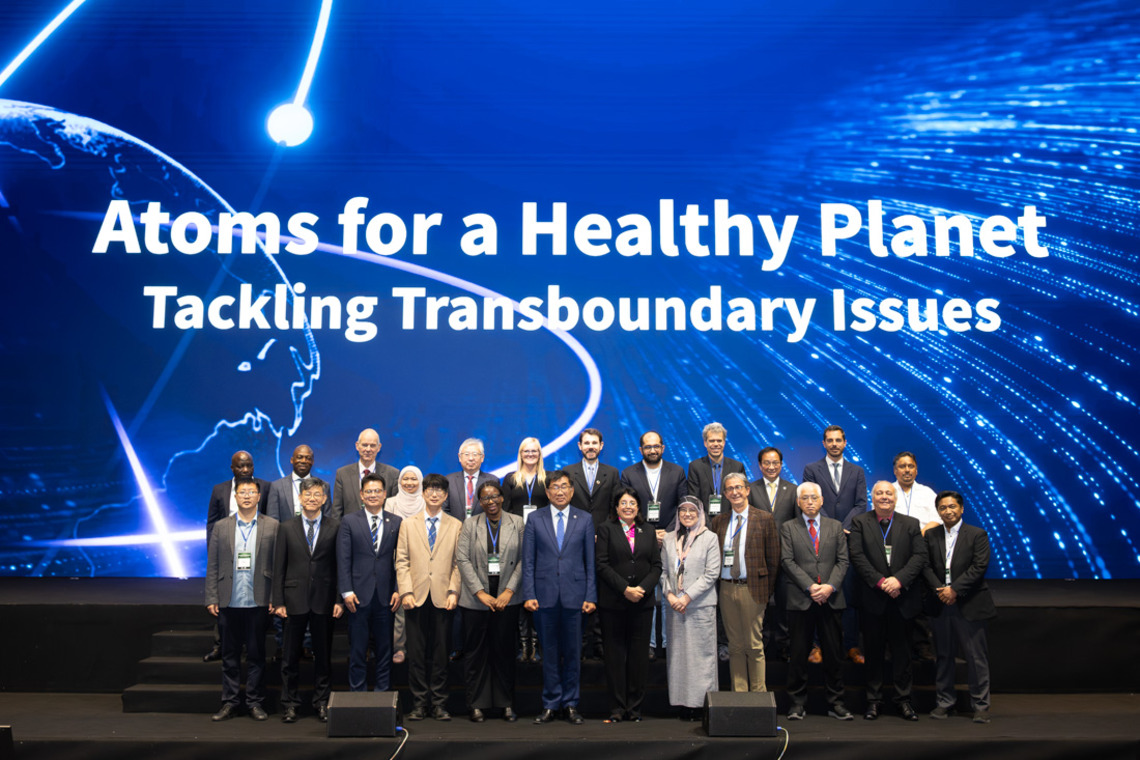
    The five-day event, “Atoms for a Healthy Planet: Tackling Transboundary Issues,” brought together some 250 participants from 35 countries, including representatives of international organizations and leading Korean research institutions. (Photo: KAERI)

    “To address transboundary threats, technological cooperation and partnership are essential,” said Han Kyu Joo, President of KAERI. “Through IAEA’s international programmes such as ZODIAC and NUTEC Plastics, Korea will continue to share its expertise and experience actively.” 

    The event concluded with a Joint Plenary Session, where participants highlighted the role of Research and Development in producing new and updated technologies to respond to emerging challenges. The participants also reinforced the importance of translating R&D outputs into applications to achieve impact, as well as the role of strong partnerships and transboundary collaborations to drive and disseminate key research and developmental output.  

    “By showcasing sustainable, science-driven solutions and defining clear roles, we’ve taken a significant step forward in strengthening the partnerships needed to address transboundary issues effectively,” Mokhtar said in closing. “Strong collaboration is the key to our shared success.” 

    午夜爱爱爱爱爽爽爽视频网站