• <menu id="888u4"><menu id="888u4"></menu></menu>
  • Uruguayan Centre of Molecular Imaging Designated as IAEA Collaborating Centre

    Najat Mokhtar, IAEA Deputy Director General and Head of the Department of Nuclear Sciences and Applications, and Alejandro Garofali Acosta, Uruguay’s Resident Representative to the IAEA and Permanent Representative to the United Nations and International Organizations in Vienna, at the 17 December 2025 signing ceremony. (Photo: S. Ramirez/IAEA)

    The IAEA has designated the Uruguayan Centre of Molecular Imaging (CUDIM) as an IAEA Collaborating Centre, cementing their long-standing cooperation in advancing the diagnostic and therapeutic applications of nuclear techniques. Over the next four years, the IAEA will work closely with the centre to enhance clinical nuclear medicine, radiopharmacy and molecular imaging capacity throughout Latin America.

    “IAEA Collaborating Centres promote the practical use of nuclear technology by supporting our programmatic activities across research, development and training around the world,” said Najat Mokhtar, IAEA Deputy Director General and Head of the Department of Nuclear Sciences and Applications, during the signing ceremony on 17 December. 

    “A recognition of its excellence, CUDIM’s designation as an IAEA Collaborating Centre marks a new milestone in our shared commitment to promote safe, high-quality and accessible nuclear medicine services,” Mokhtar said. “Together, we will continue to accelerate scientific progress, expand training opportunities and support other countries in harnessing the full potential of nuclear technology for better health and well-being.”
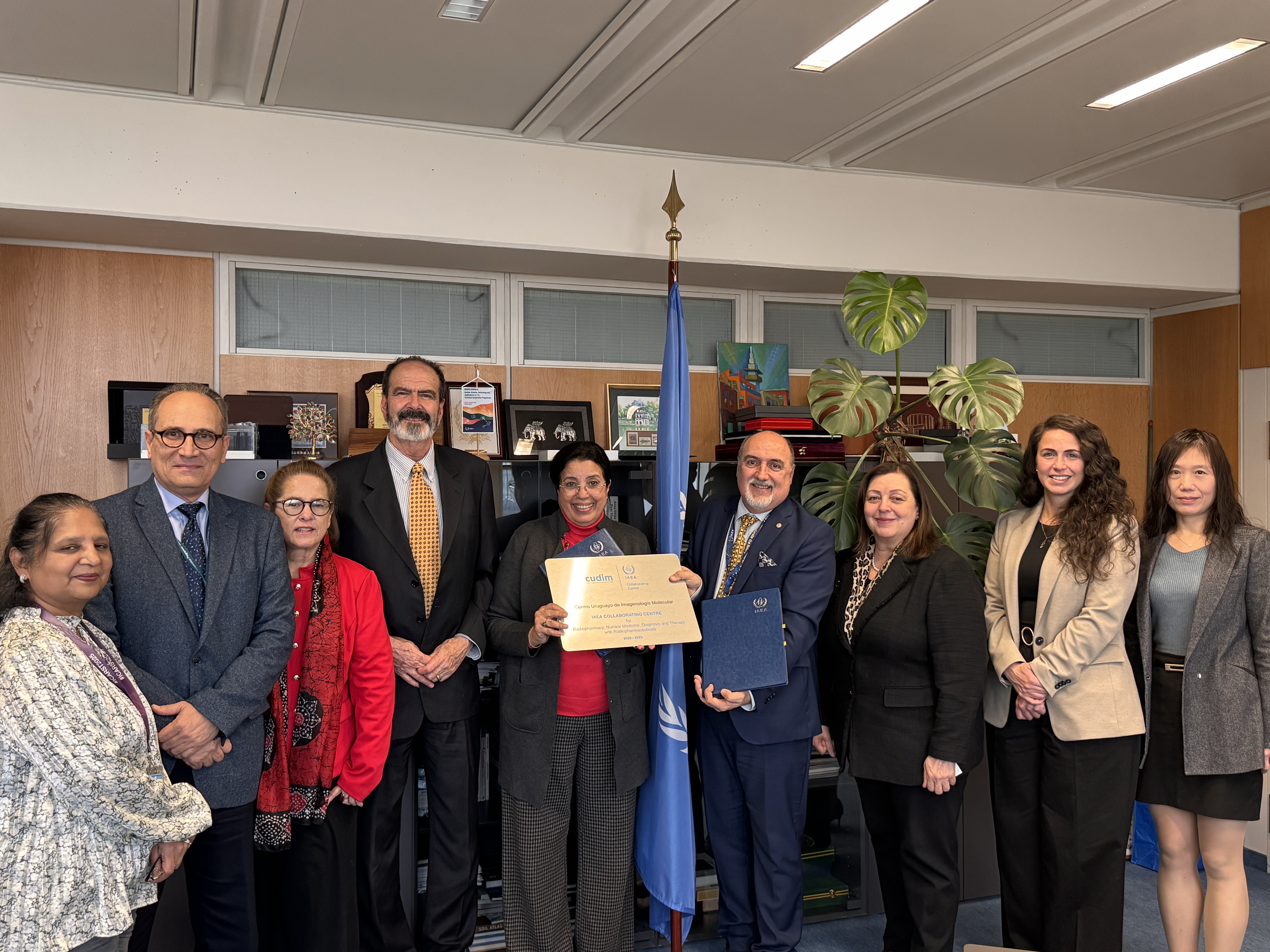
    As an IAEA Collaborating Centre, CUDIM will work closely with the IAEA to enhance clinical nuclear medicine, radiopharmacy and molecular imaging capabilities across Latin America. (Photo: S. Ramirez/IAEA)

    Under the new agreement, the IAEA and CUDIM will jointly strengthen training programmes for nuclear medicine physicians, technologists and radiopharmacy specialists. Among other activities, the new Collaborating Centre will host regional workshops, provide fellowships, assist in the development of clinical protocols and support quality assurance within medical imaging and radiopharmaceutical production. Joint research efforts will also encompass positron emission tomography (PET)-based diagnostics, emerging theranostic applications and the evaluation of new radiopharmaceuticals. 

    “It is a true honour to sign this agreement and witness today the designation of the Uruguayan Centre of Molecular Imaging as an IAEA Collaborating Centre,” said Alejandro Garofali Acosta, Uruguay’s Resident Representative to the IAEA and Permanent Representative to the United Nations and International Organizations in Vienna. “This recognition symbolizes both a national achievement and a renewal of Uruguay's commitment to the Agency's objectives in the areas of health, sciences and nuclear applications for peaceful uses.”

    Established in 2010 as a national centre dedicated to PET-computed tomography (PET-CT), magnetic resonance imaging (MRI) and radiopharmaceutical production, CUDIM has helped expand access to high-quality medical services across Uruguay – including through the introduction of nearly 30 radiopharmaceuticals for diagnostic and therapeutic purposes. Its expertise has supported the IAEA’s human health initiatives over the years through the centre’s participation in IAEA regional networks, technical meetings and projects. In terms of  research, CUDIM has assisted the IAEA in determining the diagnostic accuracy of a radiotracer for prostate cancer and helped standardize interpretation criteria when evaluating treatment response in paediatric lymphoma. For low- and middle-income countries, it has also supported an international study on using PET-CT for non-small cell lung cancer radiotherapy planning. 

    午夜爱爱爱爱爽爽爽视频网站