IAEA Finds Continued Improvement at the TRIGA Mark II Research Reactor in Morocco
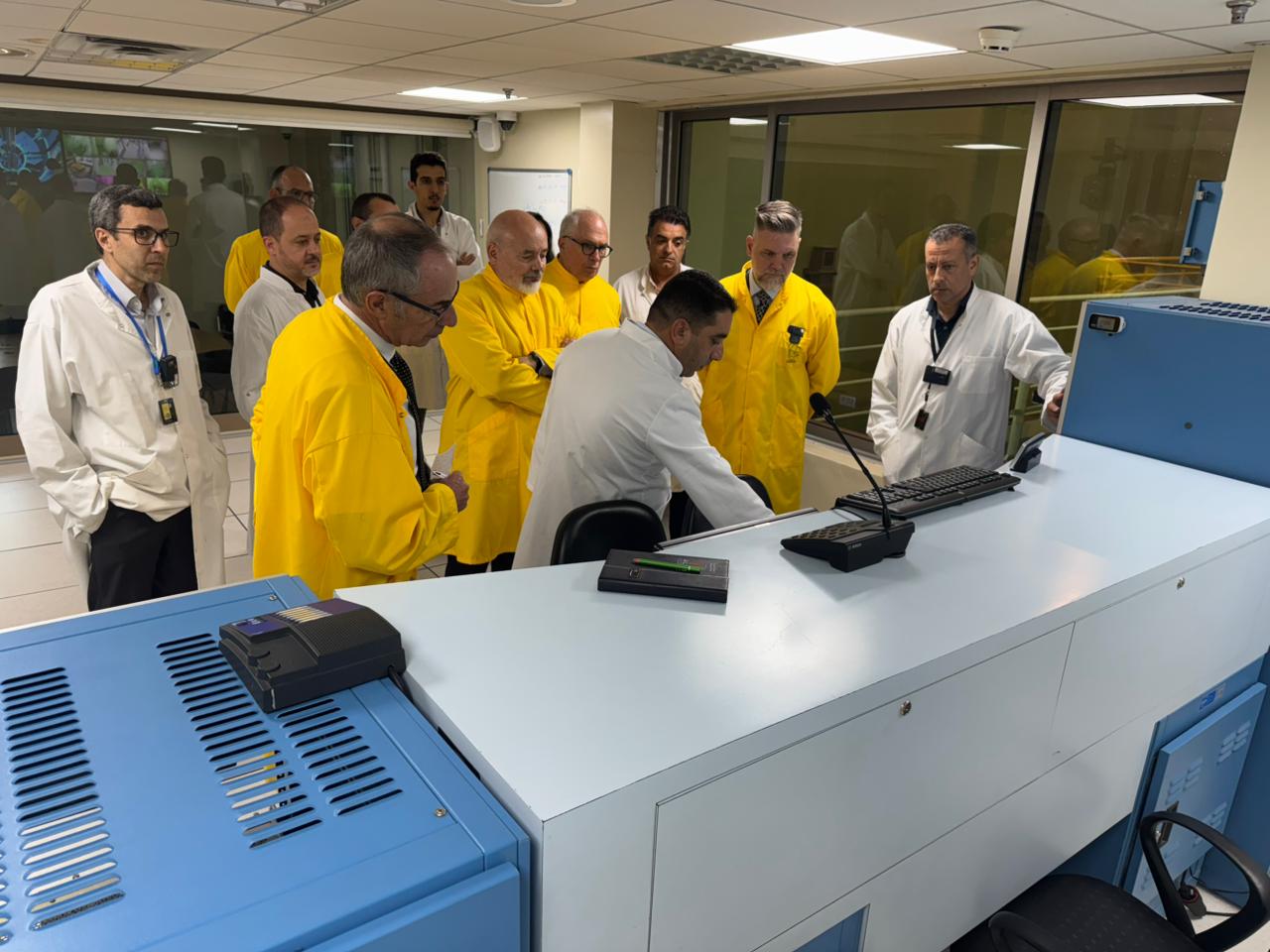
The IAEA mission team meet with experts during the IAEA Integrated Safety Assessment of Research Reactors mission.
An International Atomic Energy Agency (IAEA) team of experts observed a continued commitment by the operator to improving the operational safety of Morocco's TRIGA Mark II research reactor. The team also encouraged further improvements including to the ageing management programme and periodic safety reviews to align more closely with IAEA safety standards.
The five-day Integrated Safety Assessment Mission for Research Reactors (INSARR) mission, which ended on 14 November, was requested by the National Center for Nuclear Energy, Science, and Technology of Morocco (CNESTEN) to assess the reactor’s operational safety. The mission team consisted of three experts from Argentina, Bulgaria, and France, as well as one IAEA staff member.
The team met with CNESTEN staff as well as officials from the Ministry of Energy Transition and Sustainable Development and the Moroccan Agency for Nuclear and Radiological Safety and Security (AMSSNuR) when visiting the reactor and its associated facilities. The mission covered the organizational and management arrangements in place and reviewed technical areas: including safety analysis, operation and maintenance programmes, ageing management, radiation protection, safety of reactor experiments and modifications, and emergency planning.
The TRIGA Mark II research reactor is a 2-megawatt light water pool-type which became operational in May 2007. The research reactor plays key roles in the production of radioisotopes, neutron activation analysis, in research and development as well as training and education. The reactor is recognized as both an IAEA International Centre based on Research Reactors (ICERRs) and as a host facility under the Agency’s Internet Reactor Laboratory (IRL) initiative. Such designations reflect the facility’s expertise and commitment to capacity building, knowledge transfer, and regional cooperation in the Africa region.
The reactor underwent an INSARR mission in 2006 covering cold commissioning which was followed up with another INSARR mission in 2009. This is in addition to expert review missions that took place in 2008, 2014, and 2019.
“By requesting an INSARR Mission, CNESTEN has demonstrated commitment to safety,” said review team leader Joseph Christensen, Senior Nuclear Safety Officer at the IAEA. “CNESTEN’s commitment to safety and the implementation of IAEA safety standards is readily apparent.”
The INSARR team observed that the management system, as well as activities and procedures related to maintenance, modifications and experiments, training and qualification, and radiation protection, were implemented in line with the IAEA safety standards. The team also noted that CNESTEN is effectively managing the interface between nuclear safety and nuclear security by integrating both elements into a combined reactor safety and security committee.
The INSARR team made recommendations and suggestions for further improvements, including:
-
Updating the terms of reference for the Reactor Safety and Security Committee to ensure that all review areas important to operational safety are considered;
-
Performing a periodic safety review to assist in maintaining a high level of safety for the reactor throughout its service life; and
-
Continuing development and implementation of an ageing management programme covering all safety systems and components thus ensuring continued safe operation of the reactor.
“CNESTEN is granting high value to the outcome of the INSARR mission,” said Mr. Hamid Marah, Director General of CNESTEN. “It will not only guide our improvement efforts but will also serve as a roadmap for the coming years, ensuring that our operations remain fully aligned with the highest safety standards. Furthermore, I will be very pleased to exchange our experiences and lessons learned, including how an INSARR mission provides valuable insight into operations, with the research reactors in the framework of the south-south cooperation.”
The IAEA understands that CNESTEN plans to request a follow-up INSARR mission in 2027.
Background
INSARR missions are an IAEA peer review service, conducted at the request of a Member State, to assess and evaluate the safety of research reactors based on IAEA safety standards. Follow-up missions are standard components of the INSARR programme and are typically conducted within two years of the initial mission. General information about INSARR missions can be found on the IAEA website.
The IAEA Safety Standards provide a robust framework of fundamental principles, requirements, and guidance to ensure safety. They reflect an international consensus and serve as a global reference for protecting people and the environment from the harmful effects of ionizing radiation.